
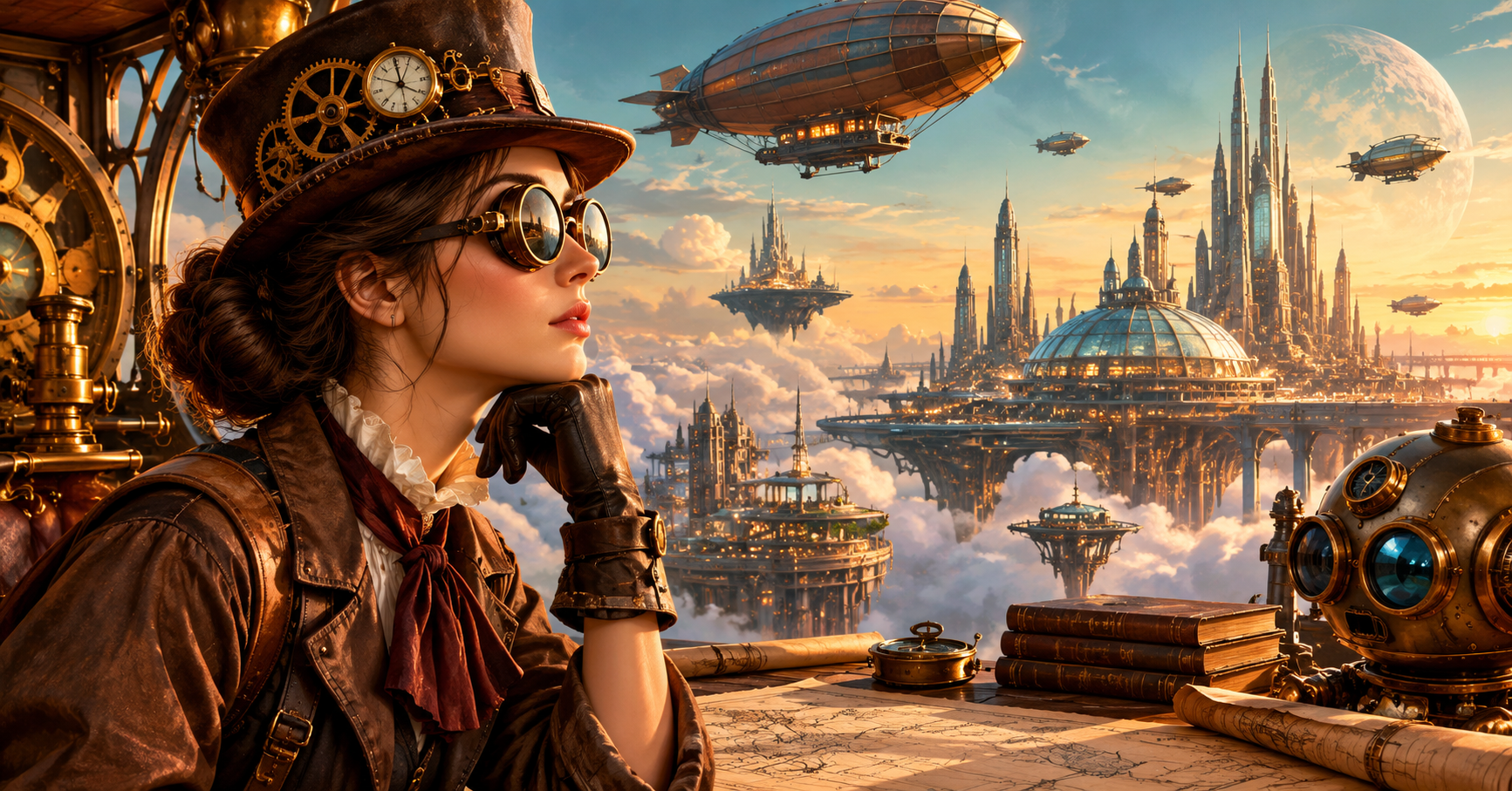

Brass gears, airships drifting through smoky skies, chrome rockets, and neon-lit diners on the Moon all belong to two closely related aesthetics: steampunk and retro-futurism. Both look at technology through a nostalgic lens, and both give digital artists, illustrators, and AI image users a lot to work with. Getting a strong result still depends on the prompt. This guide explains how to write prompts for these styles, with examples you can adapt and the reasoning behind each choice.
Understanding the Two Aesthetics
Steampunk imagines a world where steam power never gave way to electricity and combustion engines. Think Victorian-era fashion combined with clockwork machinery, copper pipes, leather, glass, and ornate ironwork. The mood is often adventurous, tactile, and slightly grimy.
Retro-futurism shows the future as people of the past pictured it. The 1950s and 60s produced space-age optimism: rounded rockets, atomic-age patterns, flying cars, and gleaming cities. Later variants include the 1980s synthwave look, with grids, chrome lettering, and sunset gradients.
Knowing the difference keeps your prompts consistent. Mixing “brass goggles” with “holographic neon interface” can work as a deliberate hybrid, but it often produces muddled images when it happens by accident.
The Anatomy of a Strong Prompt
Effective prompts usually contain five layers:
- Subject: who or what is in the image
- Setting: where it takes place
- Materials and details: textures, colors, and props
- Lighting and mood: the emotional atmosphere
- Style and format: medium, composition, or camera angle
A weak prompt reads: “steampunk city.” A stronger one reads: “A sprawling steampunk harbor city at dusk, copper-domed towers linked by suspended rail bridges, airships moored at iron docks, warm amber lanterns reflecting on wet cobblestones, wide-angle matte painting.” The second version tells the generator what to draw, where, in what light, and in what style.
Steampunk Prompt Examples
Characters
- A weathered airship captain in a long leather coat, brass monocle with rotating lenses, gloved hand resting on a ship’s wheel, storm clouds behind, dramatic side lighting, detailed digital portrait.
- A young clockwork inventor in a cluttered attic workshop, sleeves rolled up, soldering a mechanical bird, shelves of cogs and glass vials, soft window light, painterly style.
Machines and Vehicles
- A steam-powered locomotive with polished brass fittings crossing a canyon bridge at sunrise, plumes of white steam, cinematic wide shot.
- A mechanical octopus submarine with riveted copper plating and glowing porthole eyes, exploring a kelp forest, teal and gold color palette.
Environments
- A grand Victorian library where spiral staircases connect floating platforms, gears embedded in the ceiling, warm gaslight, dust motes in the air, highly detailed interior illustration.
- A bustling market street where vendors sell clockwork pets and pressure-powered gadgets, overcast sky, muted sepia tones with copper highlights.
Retro-Futuristic Prompt Examples
Atomic Age Optimism
- A 1950s-style family standing before a glass-domed suburban home on Mars, bubble-helmeted neighbors waving, pastel turquoise and coral palette, vintage travel poster style.
- A chrome finned rocket on a launchpad at dawn, art-deco signage, crowds in period clothing, screen-print texture with limited color.
Space-Age Design
- A rounded, white orbital diner with panoramic windows overlooking Saturn’s rings, waitress robot on roller skates, soft glowing menus, mid-century modern furniture.
- A monorail gliding through a city of cylindrical towers and circular sky bridges, retro concept-art style, warm sunset light.
Synthwave and 1980s Visions
- A lone driver in a convertible speeding down an endless neon grid toward a huge striped sun, palm silhouettes, magenta and cyan gradients, airbrushed illustration.
- A computer lab from an imagined 1985 future, glowing green wireframe terrain on bulky monitors, ribbon cables, dark room lit by screen glow.
Vocabulary That Improves Results
The right descriptive words steer the output more than long sentences do. A few useful groups:
- Steampunk materials: brushed brass, oxidized copper, riveted iron, tarnished bronze, worn leather, frosted glass, cogwheels, pressure gauges
- Retro-futurist materials: polished chrome, pastel enamel, molded plastic, terrazzo, neon tubing, fluted glass, streamlined curves
- Lighting: gaslight glow, golden hour, volumetric steam, rim light, neon backlight, soft diffused haze
- Composition: low-angle hero shot, isometric view, symmetrical framing, bird’s-eye view, close-up macro, vintage poster layout
- Medium: oil painting, gouache, ink and watercolor, travel-poster lithograph, matte painting, 3D render, comic-book linework
Tips for Refining Your Results
Choose one dominant color story. Steampunk suits warm coppers, browns, and deep greens. Atomic-age retro-futurism suits turquoise, cream, and orange. Naming a palette prevents chaotic color.
Add motion or story. A static machine is less compelling than one mid-action. “Steam venting as the airship lifts off” gives the image a sense of time.
Use negative prompts if your tool supports them. Terms like “modern clothing, plastic textures, blurry, extra limbs” can remove unwanted elements, especially in period scenes.
Iterate in small steps. Change one variable at a time, such as the lighting or the camera angle, so you learn what each change does.
Keep the era consistent. If you mention a Victorian setting, avoid modern clutter unless you want a deliberate contrast.
Common Mistakes to Avoid
The most frequent error is overloading a prompt with too many keywords, which leads to cluttered images where nothing stands out. Another is relying on vague words like “cool” or “epic” instead of concrete visual details. Finally, avoid naming living artists or copyrighted franchises to imitate their work. Describing the qualities you want, such as “ornate line art” or “muted painterly texture,” is more original, and it respects creators’ rights. It also keeps your output on safer ground if you plan to publish or sell it.
Turning Prompts into Projects
Once you have a few images you like, these styles work well for book covers, tabletop game art, album artwork, wall prints, and social media series. Building a consistent set of prompts around one world, such as a single airship city, gives your portfolio a recognizable identity. Keep notes on which phrases produced your best results so you can build a personal prompt library over time.
Final Thoughts
Steampunk and retro-futurism are enduring because they blend imagination with craftsmanship, one looking backward with wonder and the other forward with optimism. A good prompt describes the subject, the setting, the materials, the light, and the style in a way that leaves little to chance. Start with the examples above, adjust them to your own ideas, and keep experimenting until your images match the vision in your head.
Leave a Reply