
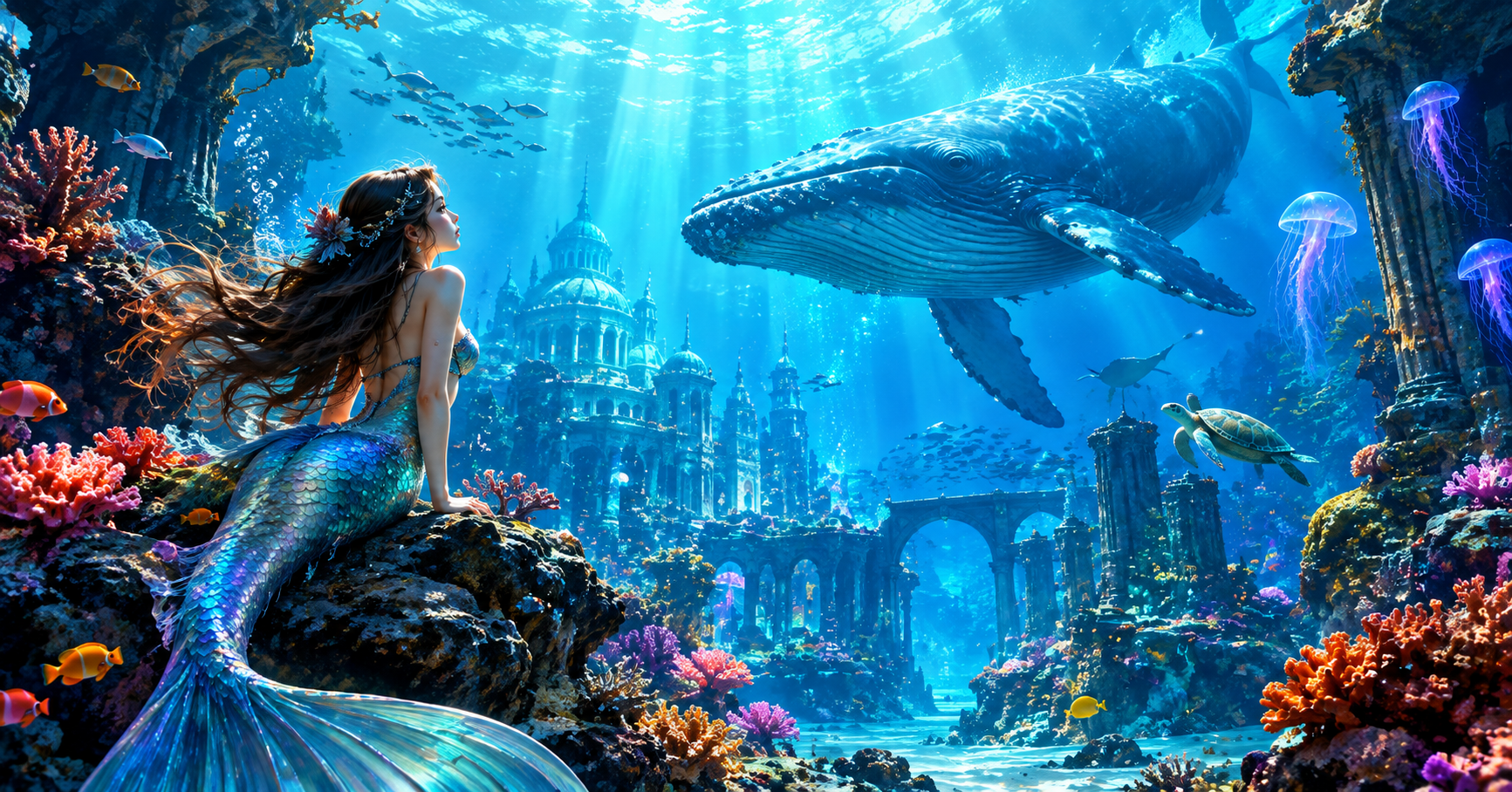

The ocean has always been a wellspring of imagination. Its depths remain largely unexplored, its creatures often stranger than anything a novelist could invent, and its shifting light creates a visual language unlike anything found on land. For AI artists, underwater and ocean fantasy themes offer some of the richest creative territory available — a genre where realism blends effortlessly with myth, and where color, motion, and mystery collide in every frame.
Whether you’re using Midjourney, Stable Diffusion, DALL-E, or any other generative art tool, ocean fantasy prompts tend to produce stunning results because the subject matter naturally rewards dramatic lighting, intricate detail, and surreal composition. Below is a deep dive into why this theme works so well, along with prompt ideas and techniques to help you create breathtaking underwater art.
Why Ocean Fantasy Themes Work So Well in AI Art
Water is inherently dynamic. It refracts light, distorts shapes, and creates natural gradients that AI models handle beautifully. Combine that with bioluminescence, coral textures, and the eerie stillness of the deep sea, and you have a genre built for visual storytelling.
Ocean fantasy also taps into universal folklore. Mermaids, sea gods, sunken cities, and leviathans appear across nearly every culture on Earth, which means AI models have been trained on a huge and varied visual vocabulary for this subject. That gives artists more flexibility to blend styles — from Art Nouveau mermaids to cyberpunk deep-sea cities — without the results feeling forced.
Core Prompt Themes to Explore
1. Mythical Sea Creatures
Sirens, krakens, sea serpents, and merfolk remain some of the most popular subjects in ocean fantasy art. Try prompts like:
- “A bioluminescent mermaid drifting through a coral cave, glowing jellyfish surrounding her, cinematic lighting, hyper-detailed scales”
- “A colossal kraken wrapping its tentacles around a sinking galleon, stormy seas, dramatic chiaroscuro lighting”
- “An ancient sea serpent coiled around a sunken temple, moonlight piercing through the water”
These prompts work because they combine a clear subject with strong environmental context, giving the AI enough detail to build a cohesive scene rather than a generic creature floating in empty space.
2. Sunken Cities and Lost Civilizations
Few concepts evoke wonder quite like a forgotten underwater world. Atlantis-style ruins, drowned cathedrals, and coral-covered statues make for visually rich compositions.
- “A sunken Atlantean city overtaken by coral reefs, shafts of sunlight breaking through the surface above, schools of fish swimming through crumbling arches”
- “An underwater library with glowing scrolls floating between stone shelves, soft blue light filtering down”
- “A drowned cathedral with stained glass windows illuminated from within, surrounded by drifting seaweed”
Adding architectural detail — columns, arches, statues — helps anchor the fantasy element in something structurally believable, which tends to produce more polished results.
3. Deep Sea Bioluminescence
The deep ocean’s natural light shows offer endless inspiration. Bioluminescent creatures, glowing plankton, and phosphorescent coral create otherworldly color palettes that feel both alien and beautiful.
- “A glowing anglerfish lure illuminating a dark abyssal trench, tiny luminous plankton scattered like stars”
- “A field of bioluminescent coral pulsing with soft blue and violet light in the midnight zone of the ocean”
- “A ghostly jellyfish swarm glowing in shades of teal and magenta, drifting through pitch-black water”
This subcategory is especially popular for wallpaper-style art and abstract pieces, since the contrast between darkness and glowing color creates striking focal points.
4. Ocean Deities and Guardians
Sea gods and guardians add a sense of scale and reverence to underwater scenes. These prompts often work best with a mix of mythological reference and elemental power.
- “A towering ocean deity made of swirling water and coral, commanding a storm above the waves”
- “A guardian spirit of the sea, half-human half-current, arms outstretched as fish swirl around them”
- “An ancient sea king seated on a throne of shipwreck debris, crown of pearls and kelp”
5. Surreal and Abstract Underwater Fantasy
Not every prompt needs a literal creature or ruin. Some of the most captivating AI art comes from abstract interpretations of the ocean itself — light, texture, and movement as the subject.
- “A dreamlike underwater world where clouds float beneath the waves and fish swim through the sky above”
- “Liquid galaxies swirling inside an ocean current, stars reflected in the water like scattered diamonds”
- “A surreal ocean made of stained glass, light refracting into a thousand colors”
Tips for Crafting Better Ocean Fantasy Prompts
Layer your details. Instead of just naming a subject, describe lighting, color palette, texture, and mood. “Glowing,” “bioluminescent,” “sunlit,” and “moonlit” all produce very different atmospheres.
Reference art styles. Adding style cues like “Art Nouveau,” “digital painting,” “concept art,” or “watercolor illustration” helps the AI understand the overall aesthetic you’re aiming for.
Use scale contrast. Pairing something massive (a kraken, a sunken cathedral) with something small and delicate (a diver, a school of fish) creates depth and narrative interest.
Experiment with color temperature. Cool blues and teals evoke calm mystery, while warm oranges and golds — like sunlight piercing the surface — add drama and contrast.
Final Thoughts
Ocean fantasy art thrives on contrast: light and darkness, ancient and alien, delicate and monstrous. Because the subject matter is so visually rich, even simple prompts can generate stunning results, while more detailed prompts allow for precise creative control. Whether you’re building a portfolio, designing book covers, or simply exploring what AI art can do, the depths of the ocean offer nearly limitless inspiration — a reminder that some of the most fantastical worlds are the ones we haven’t fully seen yet.

Leave a Reply